By Lionel Kubwimana
••4 min
A Rwandan parent abroad froze at a family photo—and how starting with one word, umugani, began to bring Kinyarwanda back into his home.
A Rwandan father living abroad once told me a story that many diaspora parents will recognize. Names and a few details are changed, but the pattern is real: a language that still lives in memory, children who speak everything else at home, and one ordinary afternoon that made the gap impossible to ignore.
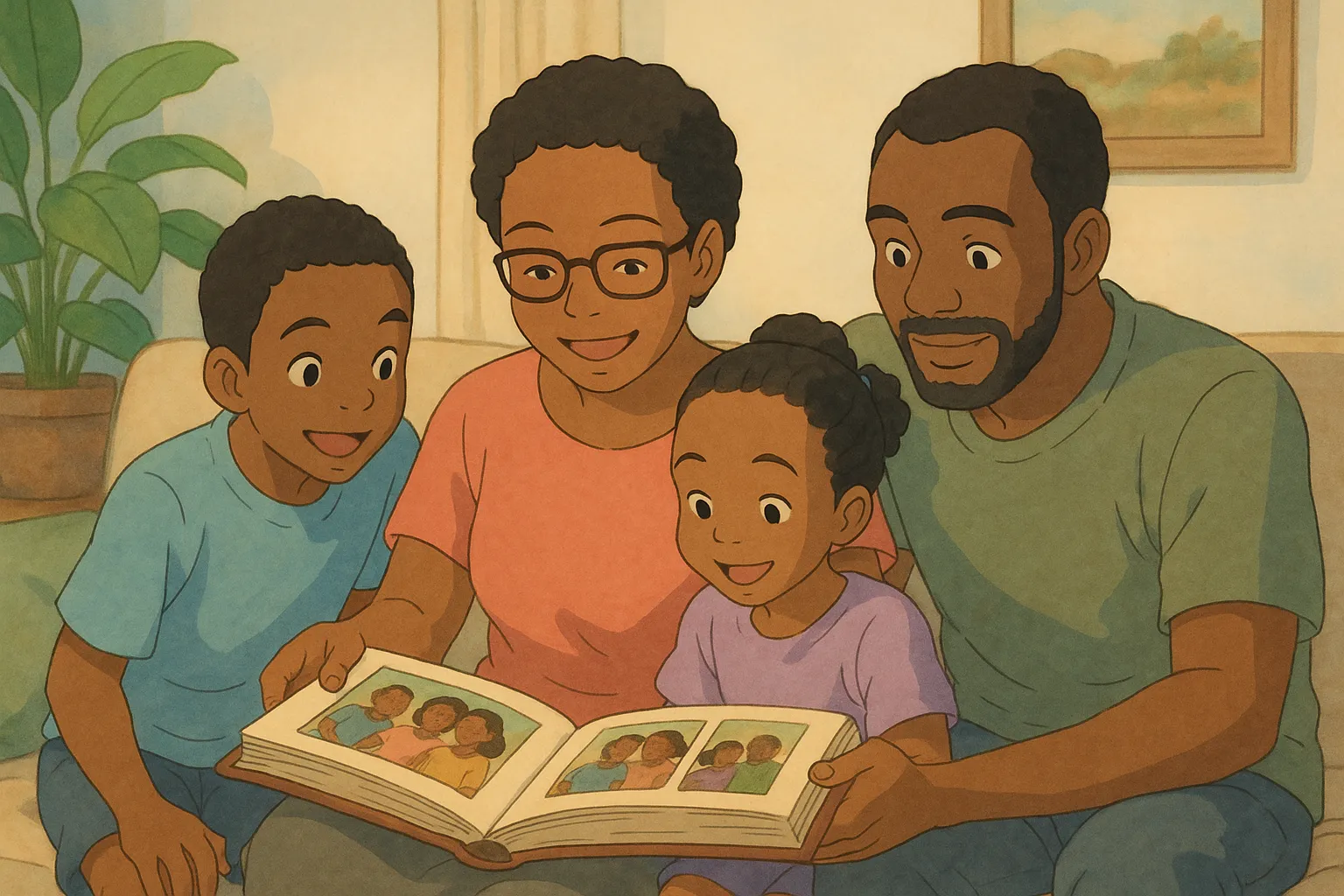
It happened on a rainy Saturday. His four-year-old daughter, Inès, sat on the floor surrounded by old family photographs he had pulled from a dusty album. She pointed to a picture of his grandmother, wearing traditional Rwandan attire, her face creased with laughter.
"Who's this, Daddy?" she asked in French, the language they speak at home.
He smiled, ready to tell her about her great-grandmother—a woman whose voice he still hears in his dreams, singing lullabies in Kinyarwanda. But as he opened his mouth, he froze. How do you say "great-grandmother" in Kinyarwanda? He knew the word—"nyogokuru"—but it felt foreign on his tongue. He had left Rwanda when he was eight, and over the years French and English had become his primary languages. Kinyarwanda had retreated to a quiet corner of his memory.
He fumbled, mixing French and broken Kinyarwanda. Inès listened patiently, but her eyes glazed over. She didn't understand. In that moment, he didn't just see his daughter's confusion; he saw a generational thread fraying. His children were growing up without the language that held their family's stories, their humor, their way of seeing the world.
That rainy afternoon was his wake-up call. He realized he wasn't just losing a language; he was letting his children lose a key to a part of themselves.
Instead of feeling overwhelmed, he decided to start small—very small. He chose one word: "umugani." It means "story" in Kinyarwanda, but it's more than that. An umugani is a tale that carries wisdom, a lesson wrapped in metaphor. It's how his grandmother taught him about kindness, courage, and community.
That night, instead of reading a French bedtime story, he told Inès a simple umugani about a little bird who finds its voice. He mixed French for the narrative but dropped in Kinyarwanda words: "inyoni" (bird), "ijwi" (voice), "umugani" (story). She loved it. She repeated the words, giggling at their musicality.
They didn't do language lessons. They didn't drill vocabulary. They just played. He labeled objects around the house with sticky notes: "imbere" (door), "ikirago" (bed), "ikiyiko" (spoon). Inès would run around pointing at them, shouting the words. His two-year-old son, Ethan, joined in, babbling his own approximations.
Over time, those single words became phrases. "Shinga imbere" (close the door). "Tuje gukina" (let's go play). The children didn't learn Kinyarwanda from worksheets; they absorbed it through daily life, just as he once had.
The shift wasn't just linguistic. It was relational. Speaking Kinyarwanda with his children created a private world between them—a space where they could share jokes, secrets, and tenderness that felt uniquely theirs. The kids started asking questions about Rwanda, about his childhood, about the family they'd never met. Language became a bridge to their heritage.
His own confidence grew, too. Reconnecting with Kinyarwanda healed a part of him he hadn't realized was wounded—the part that felt like an outsider in both his birth country and his adopted one. Slowly, he could stand more firmly in both worlds, and bring his children with him.
He also saw their minds expand. Research shows bilingual children often develop greater cognitive flexibility, empathy, and problem-solving skills. Watching small signs of that at home mattered more than any study. Inès began noticing patterns between languages, asking why some words sounded similar. Ethan started choosing the word that best expressed his emotion, even when it meant mixing French, English, and Kinyarwanda in one breath.
Friends noticed the change. Some asked how they did it. His answer was simple: start with one word. One song. One story. You don't need to be fluent; you just need to begin.
Now, Kinyarwanda isn't only a "heritage language" they study—it's becoming a living part of their home. They sing Rwandan nursery rhymes in the car. They cook traditional dishes while naming ingredients in Kinyarwanda. They video-call relatives back home, and the children can greet them, laugh with them, understand a little of their stories.
That rainy Saturday feels distant now. Today, Inès can tell her own simple umugani. Ethan chatters in a delightful mix of French, English, and Kinyarwanda. And their father? He's still learning, still stumbling over grammar, still rediscovering words he'd forgotten. But he's no longer as afraid of losing his language.
What his story reminds me—and what I want every diaspora parent to hear—is this: a language isn't preserved only in dictionaries or grammar books. It's kept alive in the voices of children, in bedtime stories, in kitchen laughter, in the quiet moments when a father and his daughter look at an old photograph and say, "Nyogokuru."
That one word started it all.