By Lionel Kubwimana
••4 min
Designate a small space as a 'language nest' where only your native language is spoken, filled with cultural artifacts that invite curiosity.
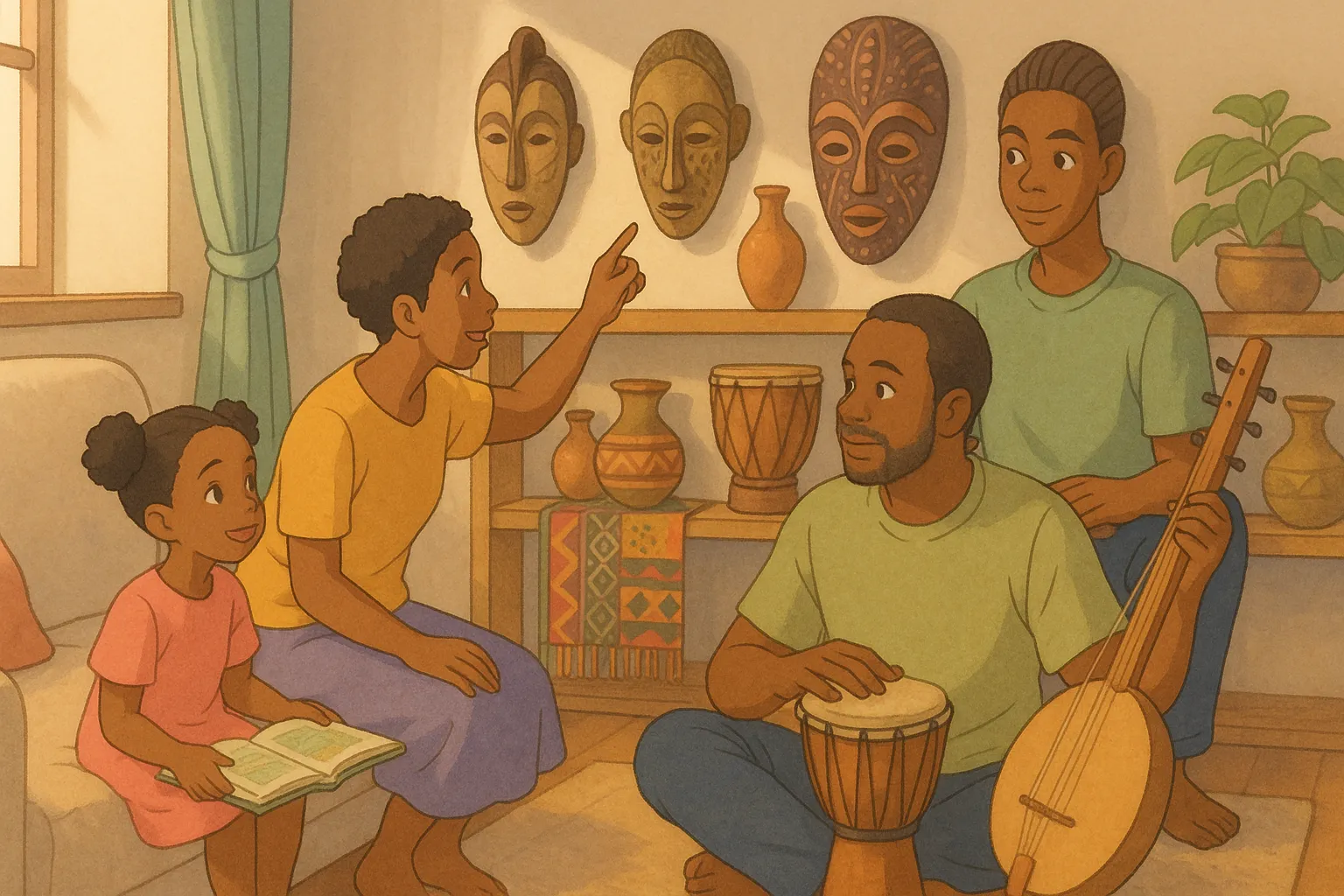
Your child speaks English at school, French with friends, and your native language only when you remind them. But what if your home could become a “language nest”—a place where your culture feels like home, not homework?
Sometimes, the distance feels impossible—an entire ocean between our children and their heritage. We imagine we have to build a monumental bridge: perfect lessons, hours of teaching, flawless grammar. And that weight can feel heavy. Too heavy to carry alone.
Then you watch your child’s face light up on a simple video call with grandma. She’s teaching them the words for fruits in your language. Laughing at the way they say “imbuto.” It’s not a bridge of steel and stone. It’s a thread, woven from laughter, repetition, and a screen glowing with love. A thread that carries more than words—it carries identity, belonging, memory.
That thread is the core of a language nest: a dedicated space where your native language is the only language, and where cultural artifacts invite curiosity, not instruction. It’s not about fluency; it’s about belonging.
Language is more than vocabulary and grammar—it’s an emotional anchor. When a child feels they belong to a culture, they want to speak its language. Research on bilingual memory shows that naming an emotion in its first language makes the feeling easier to recall and share. These special terms act like bookmarks for family stories.
Belonging is the soil in which language grows. Without it, lessons feel like chores. With it, every new word is a discovery, a piece of a puzzle that says, “This is who we are.”
Choose a space – Pick a small, consistent area: a corner of the living room, a shelf, or even the dinner table one night a week. The key is consistency, not size.
Add cultural objects – Fill the space with artifacts that invite curiosity: a traditional mask, a piece of fabric, a musical instrument, family photos, or a bowl of fruit from your homeland. The objects should be touchable, discussable, and visibly connected to your culture.
Set simple rules – In the nest, only your native language is spoken. Keep the rules simple: “In this corner, we speak Kirundi” or “During our Saturday breakfast, we use Swahili.” No corrections, no quizzes—just natural conversation around the objects.
The goal is to make the space feel special, not restrictive. It’s a mini‑sanctuary where your culture is the default, not the exception.
A language nest works best when it becomes a weekly ritual that feels special, not forced. Here’s how to make it stick:
Pick a consistent time – Saturday morning breakfast, Sunday afternoon story time, or Wednesday evening video‑call with grandparents. Regularity builds anticipation.
Keep it short – Start with 15–20 minutes. It’s long enough to feel substantial but short enough to avoid resistance.
Follow the child’s curiosity – If they reach for the drum, talk about drums. If they point to the fabric, name the colors in your language. Let their interest guide the conversation.
Celebrate small wins – When your child uses a new word, smile. When they ask a question, answer with enthusiasm. The positive reinforcement makes them want to return.
Over time, the nest becomes a place your child associates with warmth, discovery, and connection—not with pressure to perform. It’s where they learn that their heritage is a living, breathing part of home.
You don’t need to build a bridge overnight. Start with one corner, one shelf, one weekly meal. Let the thread of belonging weave itself through your home, one conversation at a time. Your child may not become fluent in a month, but they’ll know they belong—and that’s the foundation on which fluency is built.
What’s one object you’ll place in your language nest this week? Share below.