By Lionel Kubwimana
••5 min
Turn abstract proverbs into child‑friendly stories by collecting three sayings from your parents and framing them with real memories.
African proverbs are like ancient seeds—packed with potential, but they need the right soil to sprout in a child’s mind. Too often, we hand down sayings such as “A tree is known by its fruit” or “He who asks questions does not get lost” without the story, the emotion, or the personal memory that gives them life. To our children, they can sound like abstract moral lessons, disconnected from their everyday reality.
Young minds crave concrete, tangible stories. They learn through characters, conflict, and resolution—not just through a line of wisdom that floats without a context. When a proverb is stripped of its original setting, it loses its power to connect across generations. The good news is that we can restore that power by linking each proverb to a specific memory from the people who lived it: your parents or grandparents.
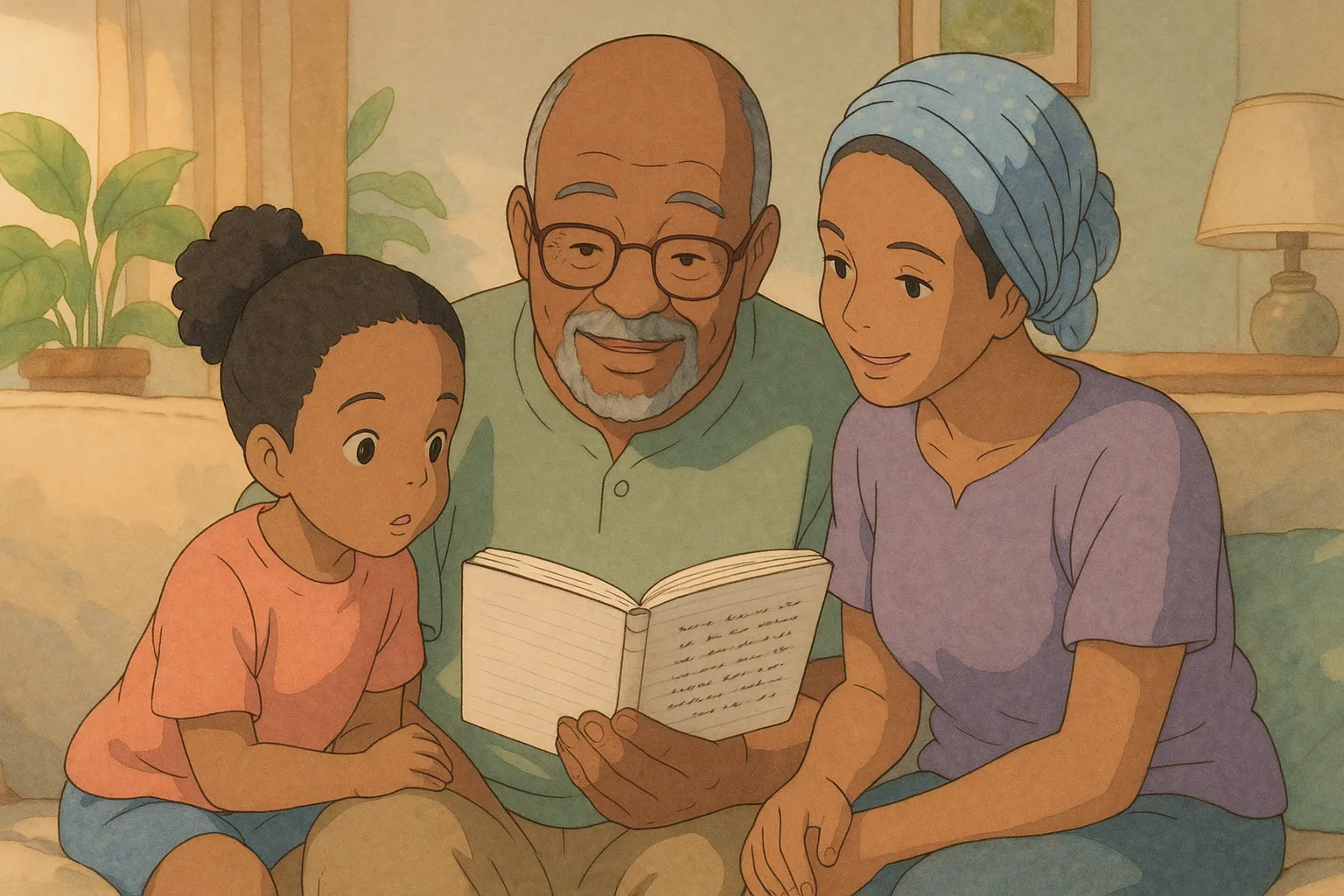
Instead of trying to recall proverbs from a book, sit down with your parents (or a grandparent) and ask them: “Which three sayings did your elders use that you remember the most—and can you tell me the story behind each one?” This simple question unlocks a treasure trove of family history.
For example, when my father told me, “The child who asks questions does not get lost,” he didn’t just quote the line—he recounted the day he got lost in the market as a boy and how his own mother used that proverb to reassure him. Suddenly, the proverb was no longer a general piece of advice; it was a moment of safety, a parent’s love, a tangible memory.
Collecting three proverbs this way ensures you have a manageable, meaningful set. It also gives each saying a natural story arc: the situation, the proverb’s role, and the outcome. These three elements are exactly what you need to turn the abstract into a story your child will remember.
Once you have the memory, you can reshape it into a one‑minute story for your child. Follow this simple structure:
Keep the story short, vivid, and emotionally resonant. Use simple language and focus on the feelings—fear, relief, courage—so your child can empathize with the character.
Repeat this process for each of the three proverbs. You’ll end up with three bite‑size stories that carry the wisdom of your ancestors in a form your child can actually use. Over time, these stories become part of your family’s oral library, ready to be retold at bedtime, during car rides, or whenever a teachable moment arises.
Don’t let these stories live only in your head. Record them. Write them down in a notebook, voice‑note them on your phone, or create a simple digital file with the proverb, the story, and a photo of the relative who shared it. This becomes your family’s proverb archive—a living document that can be added to, shared, and passed down.
When your children hear the same stories multiple times, they internalize the values behind them. They learn that wisdom isn’t just about rules; it’s about people, relationships, and resilience. And because the stories are tied to real family members, the connection to heritage grows stronger with each retelling.
This weekend, call a parent or grandparent. Ask them for three proverbs and the memories behind them. Then, pick one and turn it into a one‑minute story you can share with your child. Notice how differently your child reacts when the proverb comes wrapped in a real‑life tale.
By transforming abstract sayings into concrete stories, you’re not just preserving language—you’re preserving the heart of your culture. You’re giving your children a bridge to their ancestors, one story at a time.