By Lionel Kubwimana
••4 min
Use nostalgic games as a low‑pressure, high‑joy way to introduce vocabulary and cultural context your child enjoys.
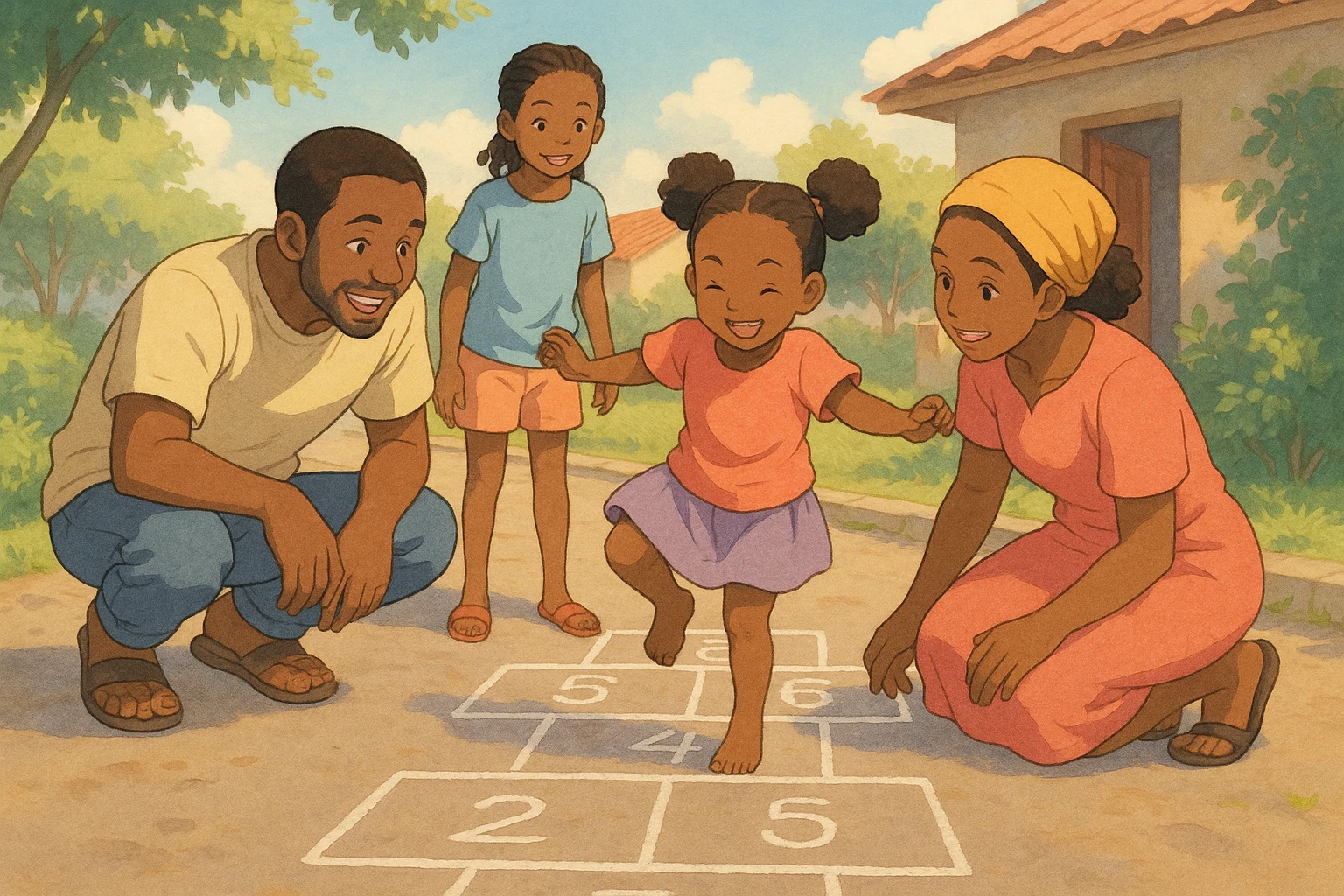
Nostalgic games have a unique power to bridge generations and cultures. They come with built‑in emotional resonance—the laughter, the anticipation, the simple joy of play that many of us remember from our own childhoods. That emotional connection is a perfect entry point for language learning. When a parent and child are already smiling, already engaged in a game they both love, the pressure to “teach” disappears. Vocabulary slips in naturally, cultural context is woven into the rules, and the whole experience feels like play, not a lesson.
A classic game of permission and movement. In your native language, the caller (“Mother”) gives instructions: “Take three giant steps forward,” “Take two baby steps sideways.” The player must ask, “Mother, may I?” before moving. This simple exchange practices polite requests, numbers, directional words, and body‑related vocabulary—all while hopping across the yard.
Beyond counting and seeking, Hide and Seek can be enriched with location words. The seeker can describe where they looked in the target language: “under the table,” “behind the curtain,” “inside the closet.” Hiders can give clues in the same language. The game turns the whole house into a spatial‑vocabulary playground.
Draw the grid with chalk on pavement, but label each square with a word or phrase in your language. As players hop, they read the word aloud. For older kids, you can write short sentences or questions they must answer before hopping to the next square. It’s physical, visual, and auditory reinforcement all at once.
The key is to keep the game recognizable. Start by translating just the essential phrases: the call‑and‑response, the counting, the names of the actions. Keep the rules identical—the fun is in the play, not in the linguistic complexity. As everyone grows comfortable, gradually introduce more vocabulary. Celebrate mistakes with laughter; the goal is connection, not perfection.
Remember, the games you loved as a child are already a part of your family’s cultural heritage. By playing them in your native language, you’re not just teaching words—you’re passing on joy, memory, and identity. And that’s a win no matter how you count it.