By Lionel Kubwimana
••4 min
The guilt of not passing your language to your child can be transformed into a simple daily ritual that works.
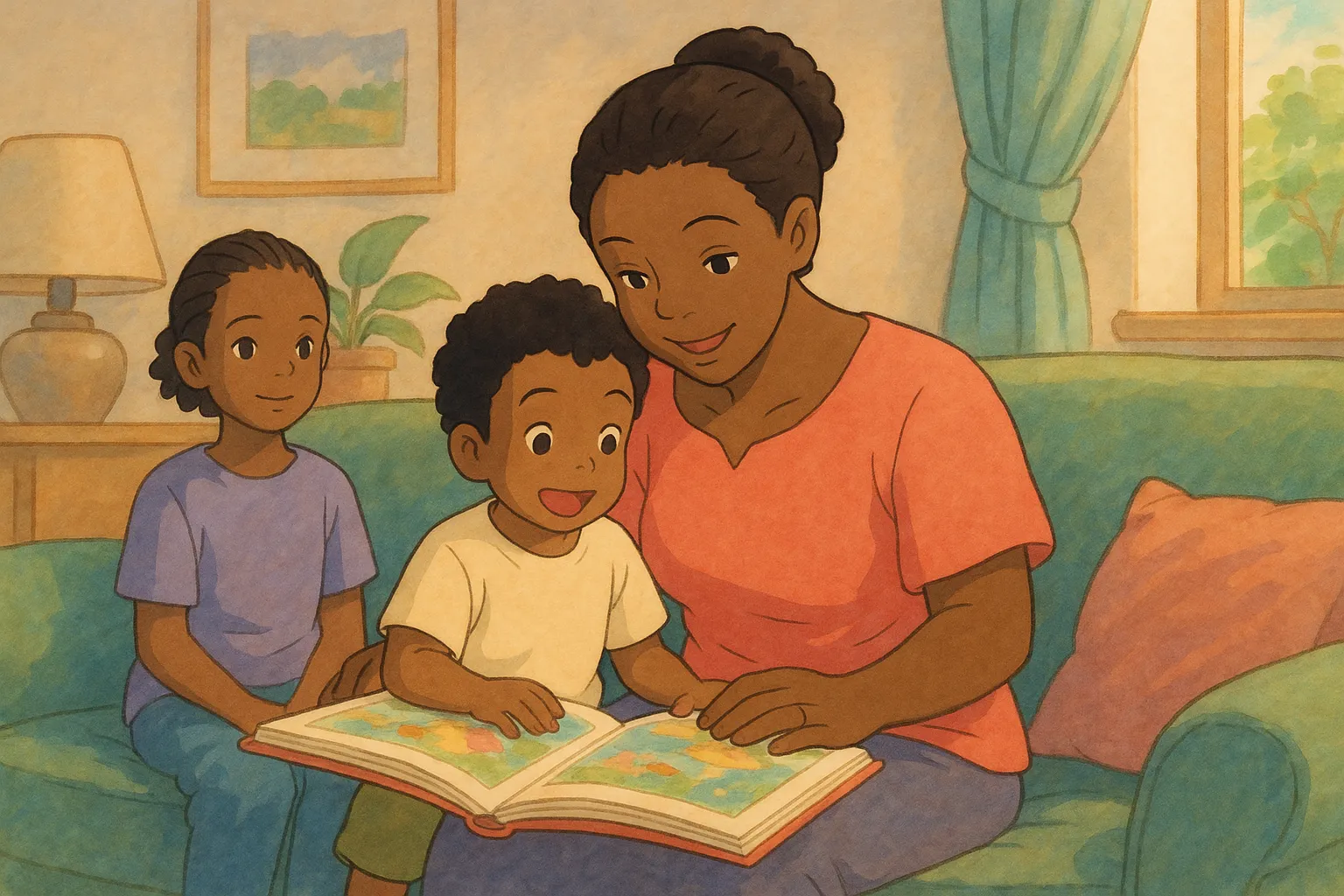
When your child replies to you in English (or the dominant community language) after you've spoken your heritage tongue, a familiar pang of failure often follows. You ask yourself: Did I not speak enough? Did I start too late? Am I not a good enough parent to pass on this piece of our identity?
This guilt is especially heavy for African diaspora parents. We carry the weight of generations—knowing that language isn't just words; it's the vessel for proverbs, songs, family jokes, and the unspoken rhythms of home. When our children don't speak it, it can feel like a cultural fracture. We blame our busy lives, our mixed‑language marriages, our own imperfect fluency. We compare ourselves to other families who seem to have succeeded, wondering what secret ritual they've unlocked that we haven't.
But guilt is a poor teacher. It makes us push harder, demand more, and sometimes even withdraw because the effort feels hopeless. It turns what should be a joyful connection into a test—for us and for our children.
Children are linguistic sponges, but they're also practical. They absorb whatever surrounds them most consistently, most usefully, and most rewardingly. If 90% of their day is filled with English‑language school, friends, screens, and activities, that's the language that will feel natural and effortless. Our heritage language, spoken only during dinner or weekend calls with grandparents, becomes the “special” language—the one that requires extra effort.
This isn't a failure of parenting. It's simple math: exposure determines fluency. A child who hears and uses a language for 30 minutes a day will never have the same command as one who lives in it for hours. And that's okay—because our goal isn't to raise monolingual heritage speakers. It's to give our children enough of the language that they can understand their roots, communicate with family, and feel a genuine sense of belonging.
The good news is that small, consistent exposure works. Studies of bilingual households show that even 20‑30 minutes of dedicated, interactive language time each day can build and maintain functional fluency over years. The key is regularity, not quantity.
Instead of trying to overhaul your family's entire linguistic environment overnight, choose one tiny, repeatable ritual. Something so small it feels almost silly—but something you can do every single day without fail.
For my family, it's “Three‑Word Dinner.” Every evening, as we sit down to eat, each person shares three words in our heritage language. They can be anything: “I am hungry,” “This tastes good,” “I saw a bird.” No corrections, no grammar lessons, just three words. If a child says something in English, we gently repeat it in our language and count that as their three words.
Why does this work?
This ritual doesn't require special materials, extra time, or perfect fluency. It simply creates a dedicated space where your heritage language is the star—not because you're forcing it, but because you're making room for it.
When you shift from “Why isn't my child speaking?” to “How can I create one small moment of connection today?” you replace guilt with grace. You stop measuring yourself against an ideal and start celebrating the real, tiny victories: the first time your child volunteers a word without prompting, the day they teach one of those words to a friend, the evening they laugh because you used a word they taught you.
Language transmission isn't a test you pass or fail. It's a journey you walk together—one three‑word step at a time.