By Lionel Kubwimana
••4 min
Use music and songs to teach African languages—rhythm makes words unforgettable, gestures reinforce meaning, and family singing creates joyful learning.
Have you ever noticed how a song from your childhood can pop into your head years later, complete with every word? That's the power of music and rhythm—they etch words deep into our memory. When teaching African languages to your children, harnessing this natural memory aid can transform language learning from a chore into a joyful family activity.
Our brains are wired to remember patterns. Rhythm creates a predictable structure that helps us anticipate what comes next, making it easier to recall words and phrases. When children hear the same melody repeated, they start to recognize the sounds, then the syllables, and finally the meanings.
Scientific studies show that musical training enhances verbal memory. The combination of melody and rhythm activates multiple areas of the brain simultaneously, creating stronger neural connections. For African languages, which often have tonal variations and rhythmic speech patterns, singing can help children internalize the correct intonation and flow.
Think of traditional lullabies, work songs, or celebratory chants from your heritage. These songs have survived generations precisely because their rhythmic patterns make them easy to remember. By using them as teaching tools, you're not just teaching language—you're passing down cultural memory.
You don't need to search for "educational songs" in your target language. Start with what you already know—the songs that bring you joy or comfort. Perhaps it's a lullaby your mother sang, a playground rhyme, or a popular tune from your community.
If you can't recall many songs, ask older relatives. Grandparents often remember songs that have faded from daily use. You can also explore online archives of African folk music or children's songs. Look for songs with clear lyrics, repetitive structures, and a moderate tempo—these are easiest for beginners.
When introducing a song, focus on one phrase at a time. Sing it slowly, exaggerating the pronunciation. Let your child repeat after you. Once they've mastered a phrase, add the next. Remember, the goal isn't perfect pitch—it's joyful participation. Even if you sing off-key, your enthusiasm will be contagious.
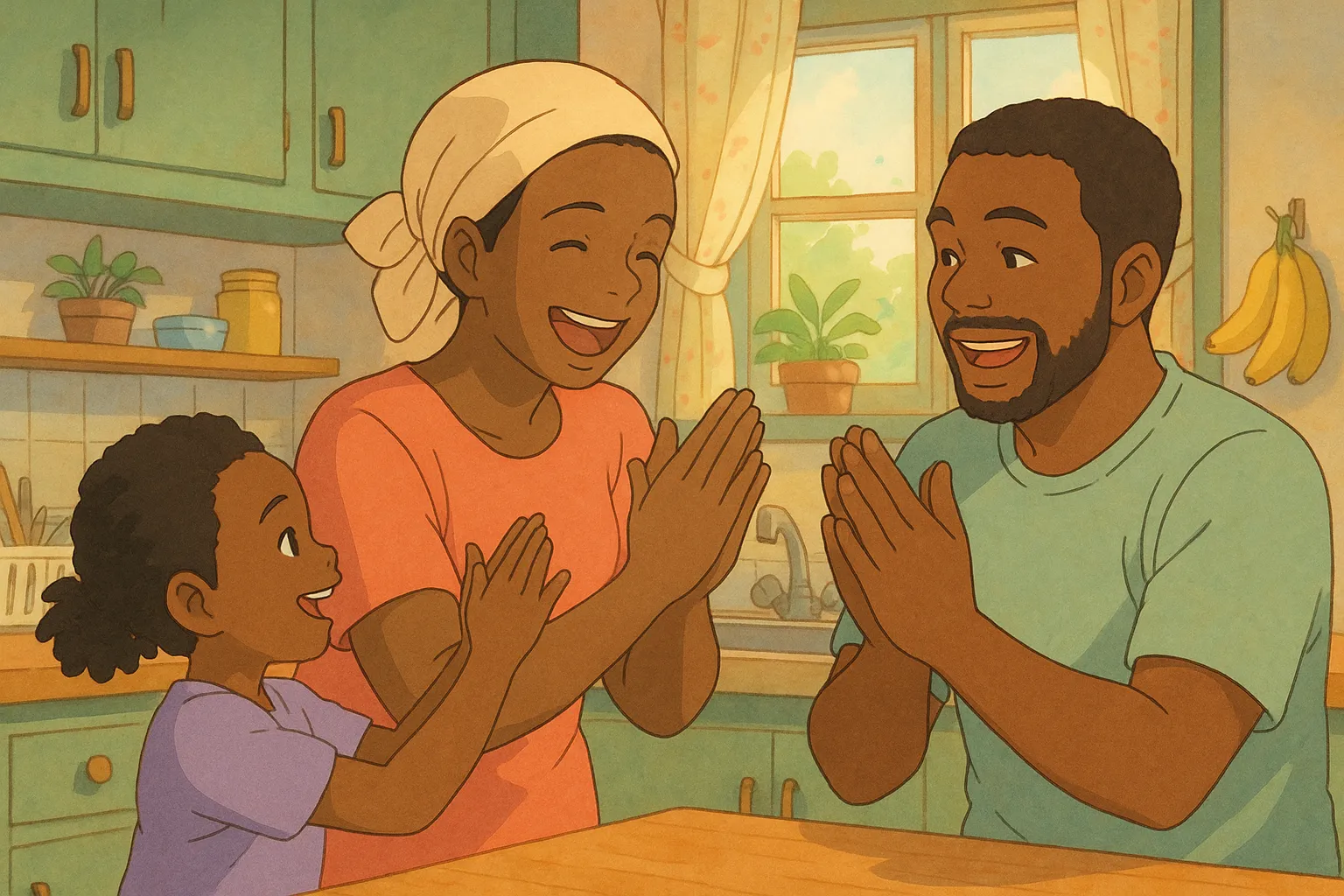
Movement deepens learning by engaging the body along with the mind. When you add simple gestures to song lyrics, you create multi-sensory associations that help children understand and remember words.
For example, if a song mentions "clapping hands," actually clap. If it talks about "rain falling," wiggle your fingers downward like raindrops. For verbs like "jump" or "dance," act them out. These physical cues link abstract words to concrete actions, making vocabulary more tangible.
You can also turn songs into games. Form a circle and walk to the beat, change direction on certain words, or pass an object around while singing. These playful interactions make language practice feel like playtime rather than study.
As your child becomes more comfortable, encourage them to create their own gestures. This ownership strengthens their connection to the language and boosts confidence.
Incorporate songs into everyday routines: a morning wake-up song, a cleaning-up tune, a bath-time melody. The consistency of routine reinforces repetition, while the variety of contexts shows how language fits into different aspects of life.
Don't worry about having a "good voice." What matters is the shared experience. Your child will remember the warmth of singing with you long after they've mastered the words.
Music and songs offer a bridge to African languages that textbooks cannot match. They carry rhythm, emotion, and culture in every note. By starting with the songs you love, adding movement, and weaving them into daily life, you create a rich, memorable language-learning environment that children naturally embrace.
So, what's the first song you'll teach? Pick one that makes you smile, gather your family, and let the music begin.