By Lionel Kubwimana
••4 min
A curated guide to the most effective bilingual books for African languages, plus practical ways to turn reading time into lasting language practice.
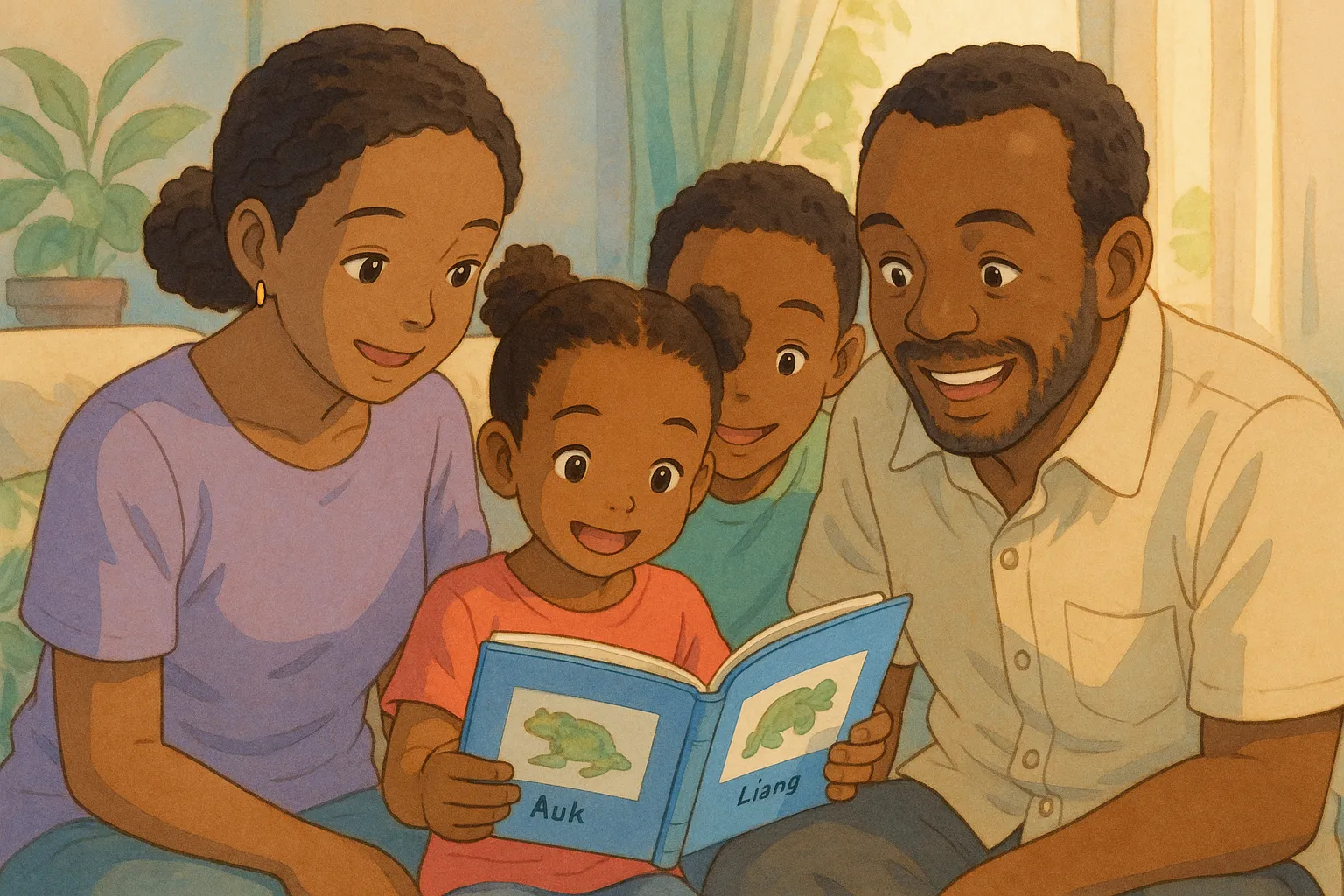
A well‑designed bilingual book is more than two languages printed side‑by‑side. It’s a gentle bridge that lets a child cross from the familiar into the new without leaving safety behind. Three ingredients separate the truly helpful from the merely pretty:
Parallel text that mirrors each sentence exactly, so the eye can hop back and forth without losing meaning. When the English reads "The cat sat on the mat," the Swahili should sit right beside it: "Paka alikaa kwenye mkeka." The child’s brain starts linking the two structures, and soon the mother‑tongue phrase feels as natural as the English one.
Cultural relevance that shows the language in its real home. If a book about going to market features oranges and bananas, a Yoruba‑English version should add "ọsàn" and "ọ̀gẹ̀dẹ̀" and perhaps a snippet of a market‑call. The setting becomes a tiny time capsule—not just a translation but a cultural snapshot.
Rich, clear illustrations that carry part of the story. A child who hasn’t yet decoded the text can follow the pictures, then match the words later. Illustrations also anchor emotional tone: a warm, bustling family scene whispers "this is your world" louder than any vocabulary list.
When these three elements align, the book does the heavy lifting. The parent reads aloud, points, asks a simple question, and the child’s curiosity does the rest. No grammar drills, no flash‑cards—just shared story‑time that doubles as a covert language lesson.
While the market for African‑language bilingual books is still growing, several gems have emerged. Here are a few that embody the principles above:
Published by Nnedi Okorafor’s imprint, these board books pair everyday objects with bright, graphic illustrations. Each spread shows a photo on the left (a bowl of rice) and a labeled drawing on the right ("ọka" – rice). The back matter includes a pronunciation guide voiced by a native speaker, a small but critical touch for parents who may have lost the accent.
A lift‑the‑flap adventure following a family on a Kenyan wildlife trip. The Swahili text runs above the English, and each animal’s name appears in both languages with a phonetic hint. The flaps hide facts about the animal’s behavior, turning a simple read into a mini‑encyclopedia. Because the story is about discovery, the language‑learning feels like part of the adventure.
This isn’t a storybook but a collection of traditional lullabies with parallel lyrics and musical notation. Each song includes a short note about its origin and the occasion when it’s sung. The real magic lies in the QR codes that link to recordings by Zulu grandmothers—so even if a parent can’t carry the tune, the child still hears the authentic melody.
Organized by theme (family, food, school), each page is a crowded, joyful scene with call‑outs for every item. The dictionary format encourages browsing rather than linear reading, perfect for the "What’s this?" stage. A companion app lets kids tap a picture to hear the word spoken, adding an auditory layer that print alone can’t deliver.
A travel‑themed book where two siblings visit Addis Ababa. Each dialogue bubble shows Amharic script, transliteration, and English translation. The book deliberately includes script rather than only Romanized text, introducing the Ge‘ez alphabet as part of the visual landscape. Sidebars explain cultural notes (why coffee is served three times, how to greet an elder), making the language feel rooted in real life.
These titles share a crucial trait: they treat the African language as a living, equal partner to English. There’s no "exotic" styling or tokenism—just clear, respectful presentation that assumes the language belongs on the shelf.
A bilingual book is a toolkit, not a one‑time event. Here are ways to stretch its value long after the first read‑through.
1. Question‑and‑answer games After a page, ask "Which word means ‘dog’ in Swahili?" Let the child point. Then switch: "What does ‘mbwa’ mean?" This turns recognition into active recall. For older kids, try "Why do you think the grandmother in the story uses that particular proverb?"—linking language to cultural reasoning.
2. Role‑play with puppets Pick two characters from the book and have them "talk" using only the mother‑tongue words from the story. A sock puppet can be braver than a child, experimenting with sounds without fear of mistakes.
3. Create your own parallel page Take a blank sheet, fold it in half, and let the child draw a scene from their own day. On the left, write the caption in English; on the right, help them write it in the heritage language using the book as a reference. This moves from consumption to creation.
4. "Spot the difference" with editions If you have the same story in two languages (e.g., "The Very Hungry Caterpillar" in English and Kinyarwanda), lay them open side‑by‑side. Challenge the child to find five words that look similar or guess meanings from context. This sharpens metalinguistic awareness—the skill of thinking about language itself.
5. Audio‑augmented reading Record a grandparent reading the book aloud, then play the recording while flipping the pages. The child hears the rhythm and intonation that print can’t convey. Later, mute the recording and have the child "read" along, mimicking the cadence.
6. The "one‑word swap" challenge Choose a common English word from the story (like "house") and pledge to use only the heritage‑language equivalent ("nyumba") for the rest of the day. Every time someone slips, they put a coin in a jar. By bedtime, the jar buys a treat—tying language practice to tangible reward.
No single book can teach a whole language, but the right one can crack the door open. It whispers to the child, "This belongs to you, too." For parents stretched thin between work, school runs, and the general chaos of diaspora life, a bilingual book offers a low‑pressure, high‑joy way to keep the heritage thread alive.
Start with one title. Read it until the pages soften. Play with the words. Let mistakes be funny, not fatal. When that book feels like an old friend, add another. Slowly, the shelf becomes a landscape—a small, bright country where both languages live together, and where your child can visit anytime they want to hear the sound of home.
The goal isn’t fluency by Friday. It’s connection. And sometimes, connection fits perfectly between two covers.