By Lionel Kubwimana
••6 min
Discover how our book's structure, illustrations, and bilingual text help you bridge the language gap effortlessly.
Most bilingual books on the market are created with a simple assumption: that the child lives in a country where the minority language is spoken at home, but the majority language dominates outside. That’s not the reality for millions of diaspora families. Our children grow up surrounded by English (or French, Spanish, etc.) at school, with friends, on screens—everywhere. The heritage language becomes a “home only” activity, often limited to short conversations with parents who themselves may be losing fluency.
Traditional bilingual books often present both languages side‑by‑side, but they rarely address the emotional gap. The illustrations feel generic, the stories lack cultural depth, and the vocabulary isn’t tailored to the daily realities of a child living thousands of miles from the homeland. The result? Kids see the heritage language as a chore, something “extra” they have to learn, rather than a living, joyful part of their identity.
Worse, many bilingual books treat the two languages as separate blocks—one page in English, the next in the target language—forcing parents to choose which version to read. That misses the point: we want our children to move fluidly between both, to see how the same idea can be expressed in different ways, and to feel proud of the words that connect them to their roots.
Our new book, “Together We Read,” was designed from the ground up with diaspora families in mind. We started by interviewing dozens of parents across the African diaspora—from London to Toronto, Paris to Melbourne—to understand what they really need. Three themes emerged again and again: relatability, ease of use, and cultural authenticity.
Relatability
Every illustration in the book is set in a contemporary home that looks like yours. The family depicted could be any African family living abroad: parents wearing casual clothes, kids playing with tablets, shelves filled with a mix of English and heritage‑language books. The scenes are warm, inviting, and intentionally familiar. When a child opens the book, they should think, “That looks like us.”
Ease of use
Instead of separating the languages, we place them side‑by‑side on the same page, with the heritage language on the left (where many African scripts start) and English on the right. The text is short, simple, and uses vocabulary that diaspora kids actually hear at home—words for everyday objects, emotions, and family interactions. We also include pronunciation guides for parents who might be rusty, plus conversation prompts at the bottom of each page to spark real dialogue.
Cultural authenticity
The story itself is a modern retelling of a classic African folktale about sharing and community, but woven into a present‑day setting. The characters have names that are common across the diaspora, and the cultural references are subtle but meaningful—a patterned fabric on the sofa, a traditional meal on the table, a proverb quietly embedded in the artwork. This isn’t a “lesson”; it’s a story that happens to carry your heritage within it.
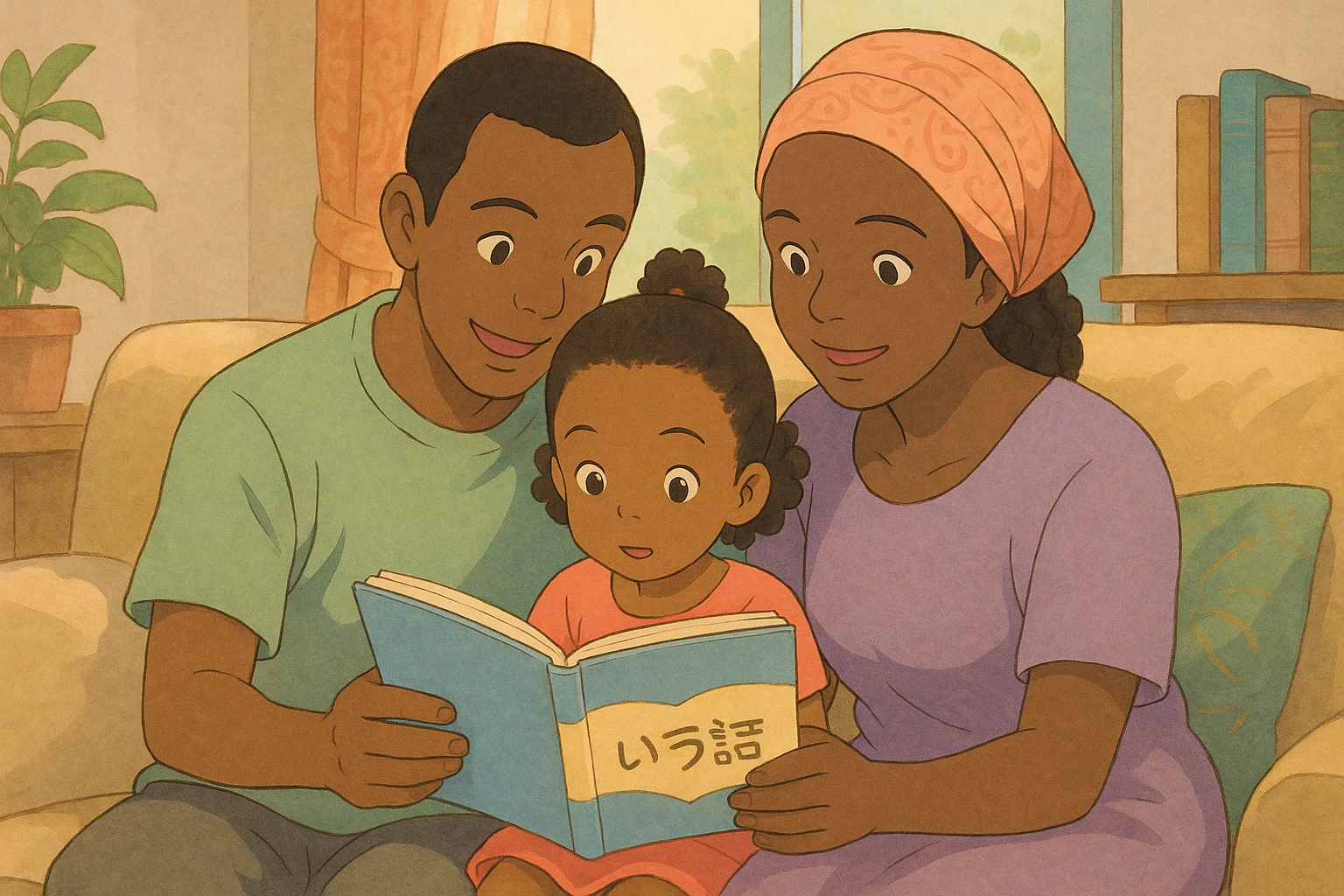
The art style was a deliberate choice. We wanted illustrations that felt magical yet realistic, something that would capture a child’s imagination without feeling like a cartoon. We turned to the soft, flowing lines of Studio Ghibli—a style beloved worldwide for its warmth and emotional depth—and asked our artists to adapt it to an African family context.
Each spread went through multiple rounds of feedback from diaspora parents. We adjusted skin tones, hairstyles, clothing, and home decor until the families in the test groups said, “Yes, that’s us.” The cover image, which shows a parent and child reading together, was especially important: it had to convey connection, joy, and the quiet pride of sharing a language.
Writing the bilingual text was equally careful. We worked with native speakers and linguists to ensure the translations were natural, not literal. Idioms were adapted, sentence structures were simplified for readability, and every word was tested with children aged 4–8. The goal was a book that a non‑fluent parent could read aloud without stumbling, and that a child could gradually start reading on their own.
The final touch: we made the physical book durable, with thick pages that survive toddler handling, and a square format that fits easily on a bedside table or in a travel bag. Because we know diaspora life is often on the go.
We hope this book becomes a bridge—not just between languages, but between generations. It’s a small tool to help keep your heritage alive, one bedtime story at a time.