By Lionel Kubwimana
••4 min
Use simple recording and storytelling techniques to preserve a single grandparent story, then share it with your child in a way that feels alive and relevant.
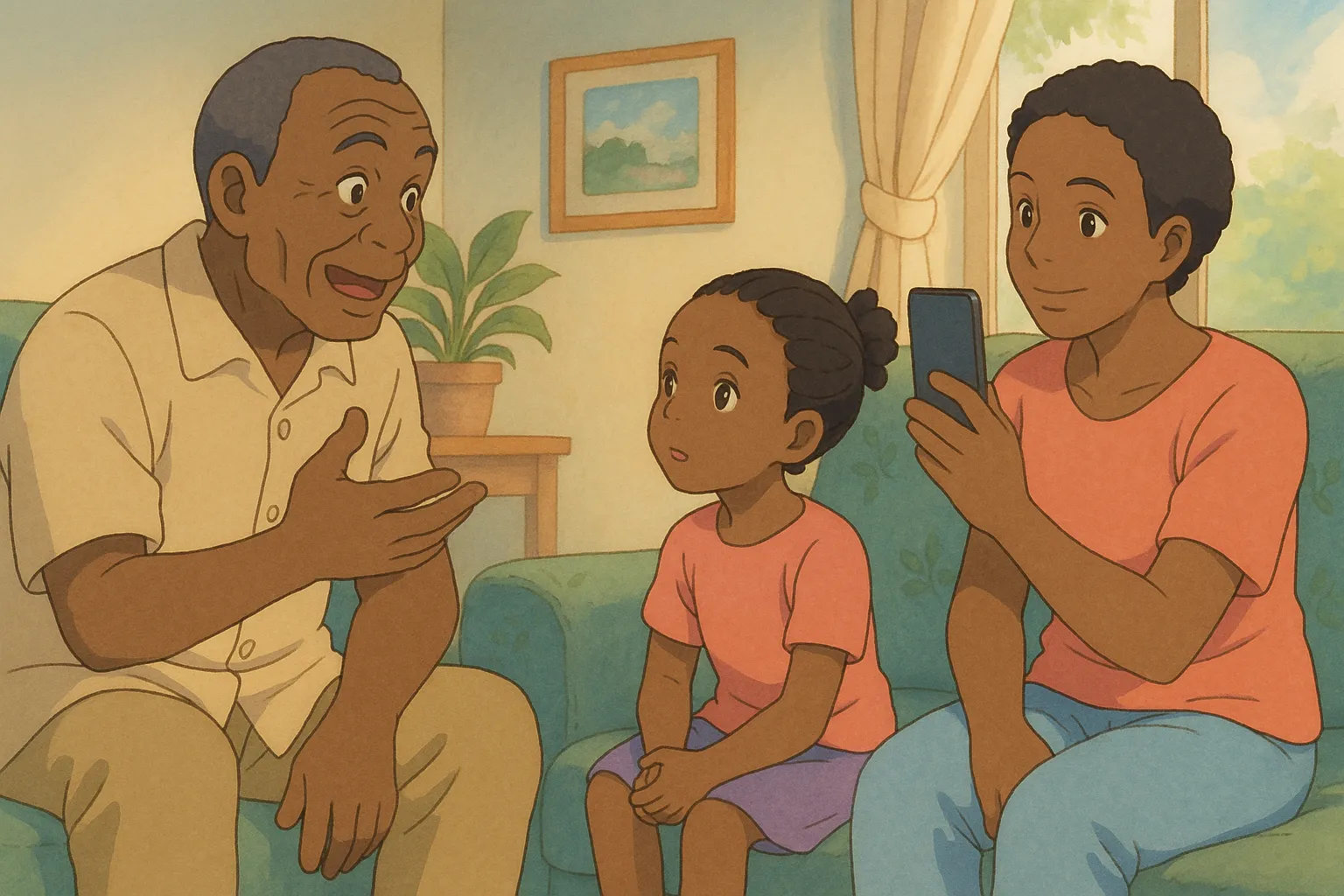
You remember the stories your grandparents told—the ones that made you feel part of something larger, that connected you to a place and a past. Now you’re afraid those stories will vanish with them. What if you could capture just one?
Stories carry more than words. They hold emotion, values, and identity—the subtle textures that vocabulary lists can never replicate. A child might learn the word “home” in your mother tongue, but a story about the mango tree in your grandfather’s village teaches them what home feels like. It’s the difference between memorizing a map and walking the land.
For diaspora parents, this is the real work of language preservation. We’re not just passing down nouns and verbs; we’re passing down a world. And the best way to do that is to preserve the stories that are still living in the voices of our elders.
The biggest mistake we make is turning a family story into a formal interview. Grandparents don’t want to perform; they want to connect. Here’s how to capture a story so naturally they’ll forget the phone is on:
1. Pick a single memory, not a life history. Instead of asking, “Tell me about your childhood,” ask, “What’s the funniest thing that happened on your walk to school?” or “What did your mother cook on Sundays?” Specificity unlocks detail.
2. Use a conversation you’re already having. The best moments happen during a regular video call, over tea, or while looking at old photos. Keep your phone recording in your pocket or set it on the table casually. Don’t announce, “I’m recording now.” Just let the talk flow.
3. Ask follow‑up questions that dig into senses. “What did that smell like?” “What color was the dress?” “How did the room feel?” These questions draw out vivid imagery that will later help you retell the story.
4. Record the audio, not the video. Audio feels less intrusive and is easier to edit later. Use your smartphone’s Voice Memos app or a simple recording app like AVR (Android) or Just Press Record (iOS).
5. Keep it short. Aim for 5‑10 minutes. One complete anecdote is worth a dozen fragmented life summaries.
Once you have the recording, the real magic begins: translating it into something your child can experience. Here are three simple ways to give the story a second life:
Listen to the recording and jot down the key beats. Then, retell it in your own words as a bedtime story, using simpler language and adding a little dramatic flair. You might start with, “Once upon a time, when your grandpa was a little boy…” This turns a distant memory into a shared nighttime ritual.
Take the story’s most visual scene and draw it with your child—stick figures are perfectly fine. Write a sentence or two on each page. You can use a free app like Canva to add text and print it as a simple booklet. Now the story lives on your child’s bookshelf, not just in a digital file.
Choose a special day—a birthday, a holiday, or a regular Sunday dinner—and make it “Grandma’s Story Day.” Play the original recording, then let everyone share what they imagined. Ask your child: “What part did you like best?” This turns a one‑time recording into a recurring family tradition.
You don’t have to preserve everything. Start with one story. Pick up the phone, call your parent or grandparent, and ask about the time they got lost in the market, or the day they first tasted ice cream. Record it. Then share it with your child this week.
That single story will do more for your child’s connection to their roots than a hundred vocabulary drills. It will give them a living link to a world they’ve never seen—and a voice they’ll remember long after the words are gone.
Because language isn’t just what we say. It’s who we are, where we come from, and the stories we tell to keep those things alive.