By Lionel Kubwimana
••4 min
Three visual prompts that turn weekly family video calls into natural language practice with grandparents.
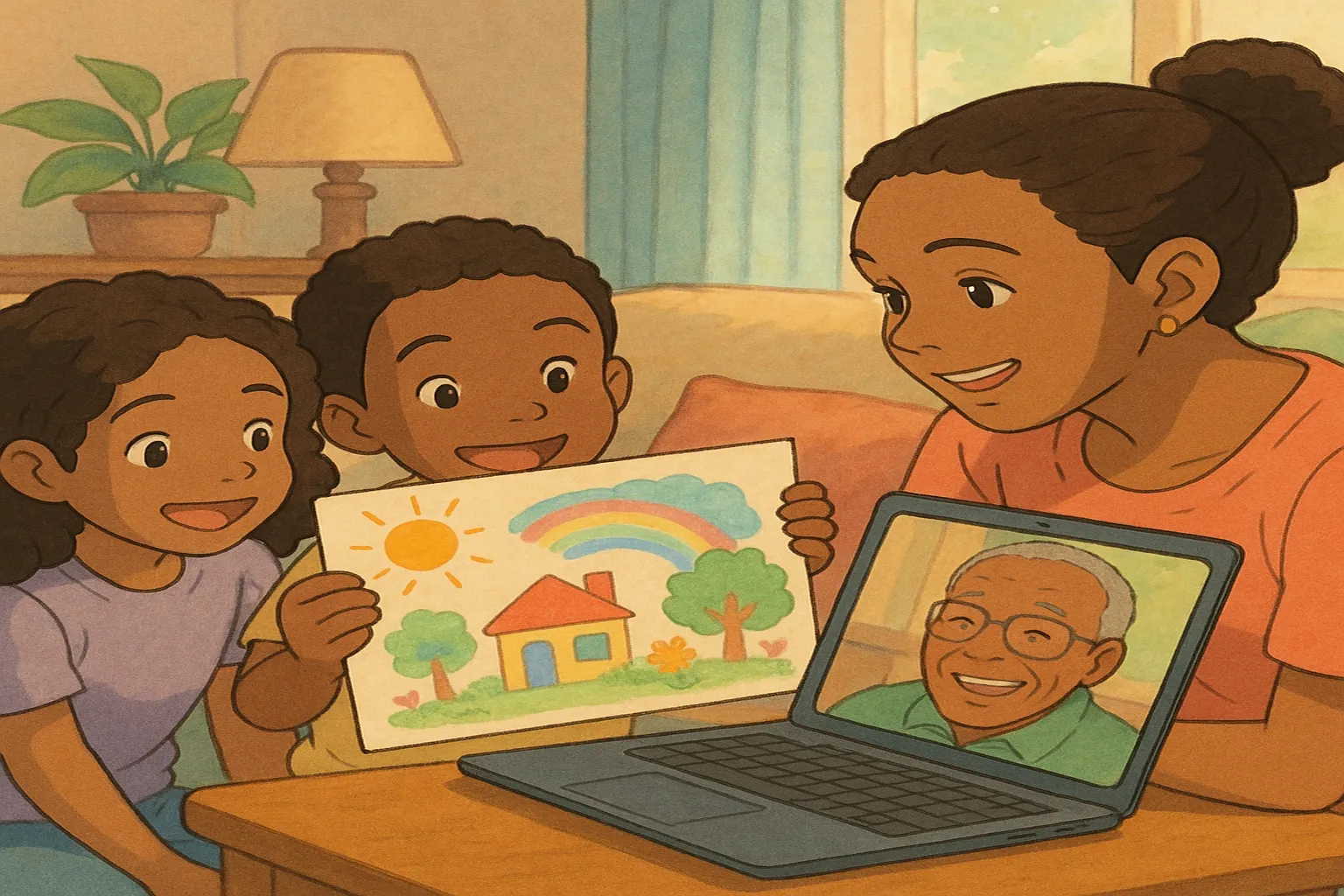
Every Sunday afternoon, the Wanjiku family in Atlanta dials Grandma in Nairobi. For five minutes, the call crackles with excitement. Then the screen goes quiet. Six‑year‑old Leo stares at the keyboard. Grandma smiles, waiting. Mom nudges him: “Say something in Kikuyu!” Leo mumbles a single word and looks away. The rest of the call is a polite exchange of “How’s school?” and “Fine, thank you.” When the video ends, everyone feels a little emptier than before.
This awkward silence isn’t just uncomfortable—it’s a lost chance. A weekly family video call could be a natural, low‑pressure space for a child to hear their heritage language, ask questions, and build a real bond with a grandparent. But without a spark, the silence smothers the language opportunity before it can breathe.
The good news: you don’t need a script or a language lesson. You just need a visual prompt—a simple object that gives both sides something to talk about. In this post, we’ll look at three prompts that turn awkward pauses into joyful exchanges, how to prepare your child and your parents, and why this small shift can protect a language that might otherwise slip away.
Video calls are strange. They flatten a three‑dimensional relationship into a rectangle of pixels. For a young child, that rectangle can feel more like a TV screen than a living person. Add in the pressure to “perform” in a language they’re still learning, and it’s no wonder they clam up.
But the bigger loss is what happens when the silence wins. Every quiet minute is a minute your child isn’t hearing the rhythm, vocabulary, and warmth of their heritage language from someone who speaks it fluently. Over weeks and months, those lost minutes add up to a shrinking connection—not just to the language, but to the grandparent who holds it.
The key is to shift the focus from “talk” to “show.” Children are naturally curious about objects, especially when they’re held up to the camera. A visual prompt gives them a reason to speak without feeling put on the spot. It also gives the grandparent a concrete starting point, so they’re not searching for questions in the void.
What to do: Before the call, ask your child to choose one toy they want to show Grandma or Grandpa. It could be a dinosaur, a doll, a car—anything they care about.
Why it works: Toys are personal. They come with stories. When your child holds up the toy, the grandparent can ask simple, predictable questions in the heritage language:
Even if your child answers in single words or mixes languages, they’re engaging. The grandparent can then tell a quick story about a toy they had as a child, using simple vocabulary. The object anchors the conversation, so the language flows around it instead of straining to fill empty air.
What to do: Have your child create a drawing specifically for the call—something they know the grandparent will like (a flower, a house, a family portrait). Keep it simple; the goal isn’t art class, it’s conversation.
Why it works: Art is open‑ended. A drawing gives the grandparent endless ways to ask questions:
Because the child made the drawing, they already have words for it—even if those words are in English. The grandparent can supply the heritage‑language terms (“That’s a beautiful nyumba!”) and the child will absorb them in context. Plus, the drawing becomes a shared reference point for future calls (“Remember the house you drew last time? What would you add today?”).
What to do: Pick a snack your child enjoys and that the grandparent will recognize—a piece of fruit, a cookie, a cup of tea. Have it ready when the call starts.
Why it works: Food is cultural. It’s also sensory, which makes it easier to talk about. The grandparent can ask:
This prompt often leads to stories about food from the grandparent’s childhood (“When I was little, we used to pick mangoes right from the tree”). Those stories are rich with heritage‑language vocabulary and cultural nuance. And because eating is a routine activity, it normalizes using the heritage language in everyday situations.
Keep it simple and reassuring. A day or two before the call, send a quick message:
Hi Mama, on Sunday Leo is going to show you his favorite toy during the call. He’s excited! Could you ask him a couple of questions about it in Kikuyu? Something like ‘What’s its name?’ or ‘What color is it?’ No pressure—just whatever feels natural. He might answer in English or mix languages, and that’s totally fine. The main thing is he gets to hear you speak Kikuyu about something he cares about.
This does three things:
If your parents aren’t comfortable with technology, you can even suggest the exact questions they might ask. The goal is to make them feel helpful, not put on the spot.
Frame the prompt as a game, not homework. An hour before the call, say something like:
Hey Leo, today when we talk to Grandma, you get to show her your dinosaur! She’s going to ask you a few questions about it in Kikuyu. If you don’t know the word, you can say it in English or point. It’s just a game—no right or wrong answers.
For younger children, you can practice once or twice (“What will you say if Grandma asks what color it is?”). But keep it light. If they resist, don’t force it. The point is to lower the barrier, not raise it.
When you use visual prompts consistently, something subtle begins to shift. The calls become something your child looks forward to, because they know they’ll have something to share. The grandparent feels more connected, because they have a way to engage that doesn’t rely on small talk. And the heritage language starts to weave itself into those shared moments—not as a subject to be studied, but as the medium for talking about a toy, a drawing, a snack.
Over time, you might not need the prompts anymore. Your child will start the call by running to get a book they want to show. Your parent will begin with a question about the weather outside. The conversation will find its own rhythm, because the silence has been broken.
And that’s the real goal: not a perfect bilingual exchange, but a living connection that keeps the language—and the relationship—alive, one small object at a time.
Next step: Pick one prompt for your next family video call. Put the object near the computer the night before so you remember. Then watch what happens when the screen stops being a barrier and starts being a window.