By Lionel Kubwimana
••4 min
Learn how to navigate the rich tapestry of dialects in African languages, embrace linguistic diversity, and teach multiple variations to your family without confusion.
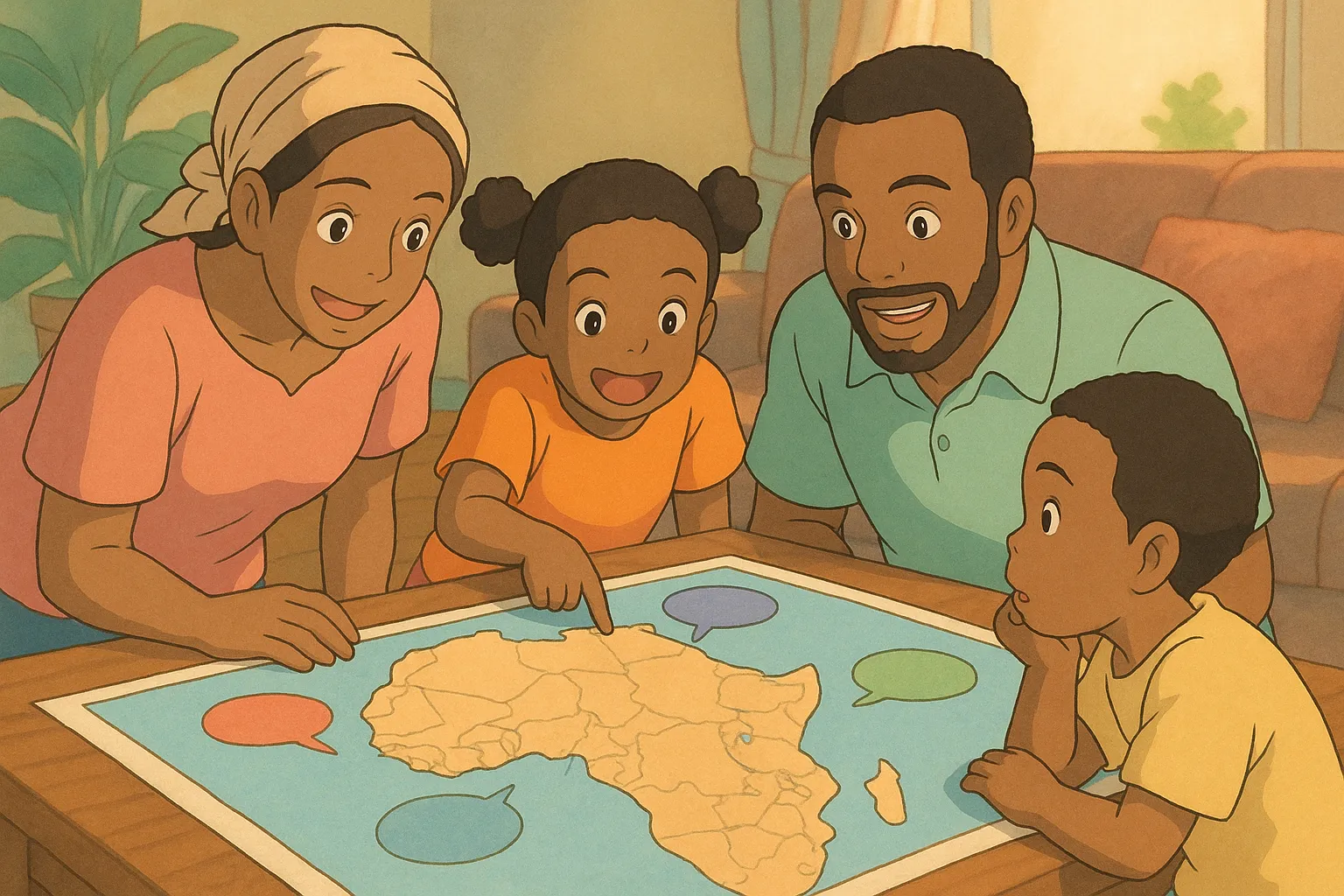
When your family speaks an African language with multiple dialects, you’re not just dealing with different words—you’re holding a map of history, identity, and community. Each variation carries the echoes of migration, trade routes, and cultural exchanges that shaped your ancestors’ world. In our home, we’ve learned that navigating these dialects isn’t a challenge to overcome; it’s an opportunity to deepen our connection to our roots and enrich our children’s understanding of who they are.
Dialects are living records of a people’s journey. The way a word is pronounced in one region might reveal centuries of interaction with neighboring communities. In many African languages, dialect differences reflect historical boundaries, social structures, and even environmental adaptations. For example, coastal communities might have vocabulary tied to fishing and maritime life, while inland dialects include terms for farming and livestock.
Embracing these variations helps our children see language not as a fixed set of rules, but as a dynamic, evolving tapestry. It teaches them that their identity isn’t monolithic—it’s layered, diverse, and beautifully complex. When we honor each dialect, we honor the communities that kept it alive.
Start by naming the dialects. In our family, we call them “Grandma’s way” and “Auntie’s way.” This personalizes the differences and makes them feel like part of our story rather than abstract concepts. We also use visual aids: a simple map of Africa with speech bubbles showing how the same phrase is said in different regions can turn a lesson into a game.
Focus on high‑frequency words first—greetings, family terms, everyday objects. When our kids hear “hello” spoken three different ways, they learn that there’s more than one “right” answer. We avoid correcting them; instead, we celebrate each version they try. The goal isn’t perfect replication; it’s awareness and appreciation.
Stories and songs are natural dialect carriers. Folktales often vary from region to region—the same story might have different characters, endings, or moral lessons depending on where it’s told. We collect versions of the same tale and read them side by side, pointing out the linguistic variations.
Music is even more powerful. Many African songs have regional versions where the melody stays the same but the lyrics shift slightly. Singing these together shows our children that dialect differences can be melodic, playful, and unifying. We’ve turned “spot the difference” into a family car‑game, and now our kids proudly notice dialect markers in the media they consume.
Navigating dialects isn’t about mastering every variation. It’s about cultivating curiosity, respect, and a sense of belonging to a wider linguistic family. By making dialect diversity a normal, celebrated part of our language practice, we give our children a gift: the ability to move gracefully between worlds, to connect with relatives across distances, and to carry forward the full richness of their heritage.
Let’s make room for all the ways our language can be spoken—because every dialect is a thread in the fabric of who we are.